turskakozmetikaE-commerceAdvertorial funnelMeta Ads2026

The ads were earning the click. The product page was losing the sale.

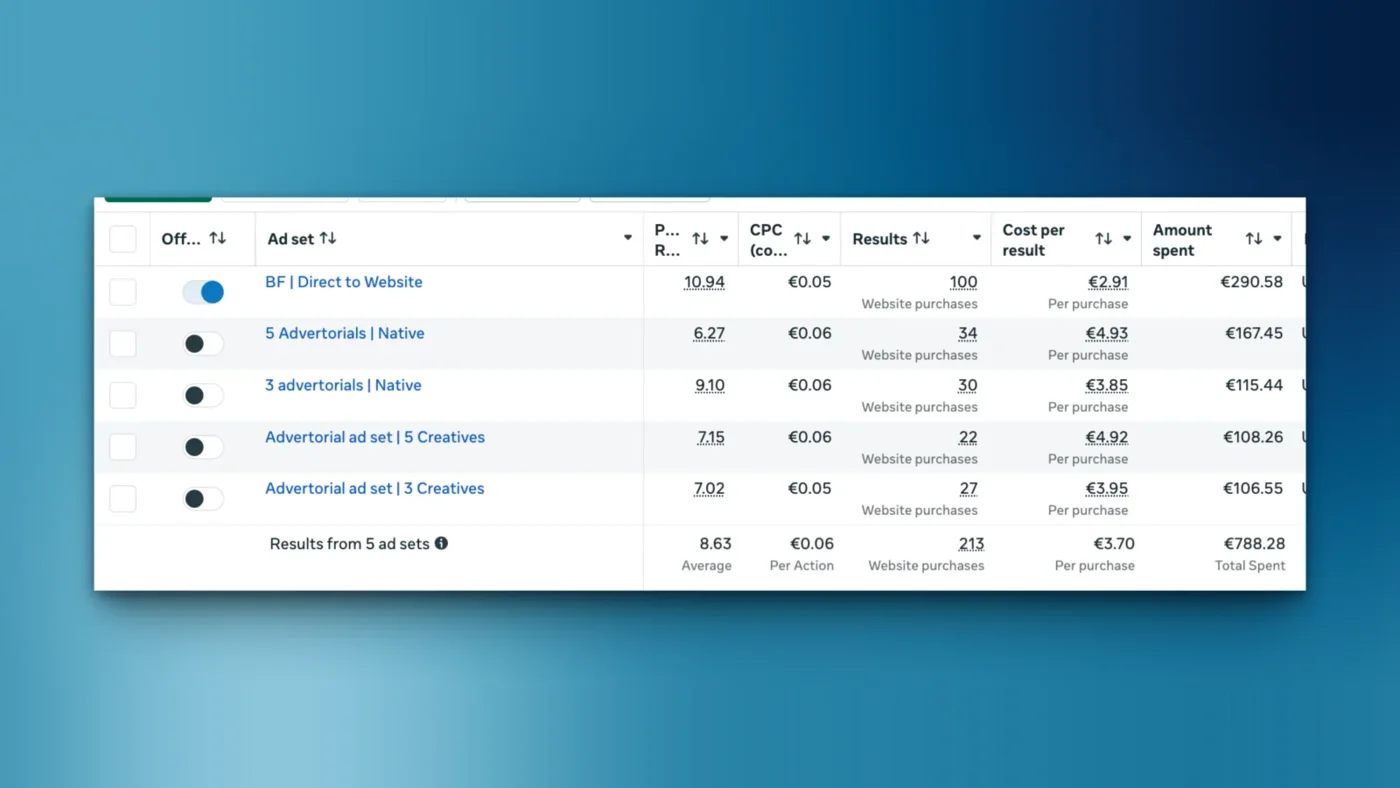
Same product, same 15 euro a day. Return on ad spend went from 2.24x to 8.63x once there was a page between the ad and the store.

turskakozmetika interface

Services

  • Customer research
  • Advertorial copy, design and build
  • Native ad creative
  • Meta Ads management
  • Weekly creative testing

Long story short

turskakozmetika sells herbal wellness and cosmetic products through a Shopify store. Their lead product is a 30-day herbal tea protocol at 29.99 euro. They were already running Meta ads straight to the product page, and the account was returning 2.24x: enough to keep going, not enough to grow.

Customer research, an advertorial placed between the ad and the store, native ad creative built on the same angle, and a weekly testing cycle. The daily budget never changed.

Highlights

8.63x
Return on ad spend, up from 2.24x
213
Purchases from 788 euro of spend
€3.70
Cost per purchase
€15
Daily ad budget, unchanged

The Goal

Profitable, and stuck

The account was not broken. Over the thirty days before the rebuild it spent 377 euro and returned 843, a blended 2.24x. One campaign ran at 0.98x and lost money. A couple of creatives did well for a week and then faded.

That is the most common state for a small store on Meta: good days followed by dead ones, and no way to tell which you are about to have. The brief was to make the return predictable enough that raising the budget would be a decision rather than a gamble.

The budget itself stayed at 15 euro a day throughout. Whatever changed, it would not be the spend.

The Gap

The page was answering a question nobody had asked yet

The ads were doing their job. People clicked. Then they arrived on a product page that told them what was in the box and what it cost.

A product page is written for someone who already wants the product. The woman tapping this ad did not. She had tried diets, pharmacy teas and tablets from the internet, and she had stopped believing the next thing would be different. She was not asking what it costs. She was asking why nothing had worked.

Nothing on the product page answered that. So the price arrived before the reason, and it read as one more cost rather than a fix. The funnel data said the same thing in numbers: the leak was after the click, not before it.

The Gamble

Adding a step to a funnel

Every rule of conversion says remove steps. I added one.

The advertorial is a long page that sits between the ad and the store. It explains why weight gain after forty is not a failure of willpower, what is actually happening, and only then introduces the product. It costs you readers: roughly one click in four never reaches it. The bet is that the ones who do arrive at the product page already convinced.

The creative had to match. I tested formats against each other every week and kept what the numbers kept. A plain image of a handwritten cardboard sign beat everything designed to look like an ad. A sticky note pulled clicks that rarely added to cart. A clinical, doctor-led image was dropped by the algorithm within days. A direct-offer creative collapsed to cents of spend.

One angle survived all of it: removing the blame. When frequency climbed past three and a winner began to tire, it was replaced by a successor built on the same angle.

The Gain

Same budget, a different account

Across one 25-day window, 15 May to 8 June, 379 euro of spend returned 2,745 euro across 82 orders: 7.24x. By the end of June the advertorial campaign had spent 788 euro for 213 purchases, an 8.63x return at 3.70 euro per purchase. Over the same month the store's conversion rate rose 38 percent.

Of the people who read the advertorial, 12 percent added to cart. The best single creative returned 9.28x on 104 euro.

This is a small account and I am not presenting it as a scaling story. Fifteen euro a day proves the funnel works, not how far it stretches. It is also not finished: fewer than half of the people who add to cart reach checkout, which makes the store's own checkout the next thing to fix, and the cheapest.

What changed is that the account became readable. There is a control, a weekly test against it, and a written record of what won and why. The next euro of budget is a decision.

What it changed

  • Return on ad spend rose from 2.24x to 8.63x across 788 euro of spend
  • Cost per purchase settled at 3.70 euro against a 28 euro average order
  • Store conversion rate rose 38 percent month on month, to 2.78 percent
  • One angle, found by testing, produced 63 percent of tracked orders

More work